Ice detection
Germany
51 % less downtime with smarter ice detection

Project summary
Location
Germany
Turbine Type
Enercon E115
Chosen products
Wind turbine operators in icing-prone regions face a persistent dilemma: ice detection systems that react too conservatively cause unnecessary downtime and lost revenue, while systems that are too permissive create safety and liability risks. Real-world, side-by-side comparisons between detection systems on the same turbine are rare, which makes this field evaluation particularly relevant.
The challenge: conservative detection causing excess downtime
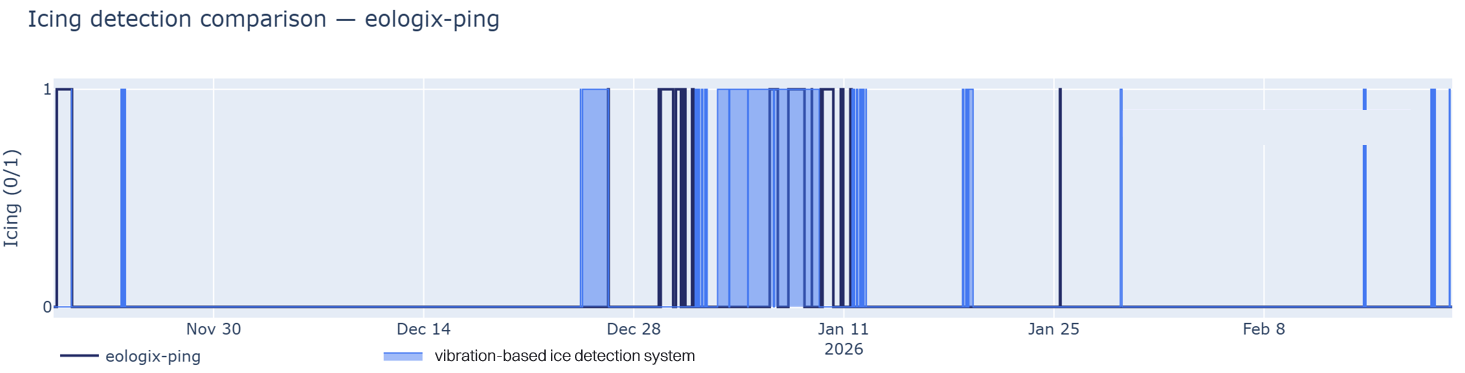
The Enercon E115 in question was equipped with both the EOLOGIX-PING blade-mounted ice detection system and a co-installed vibration-based ice detection system. Analysis of the SCADA data confirmed that the vibration-based system was the one actually issuing shutdown commands in practice, while the EOLOGIX-PING system signals were not yet integrated into the turbine control.
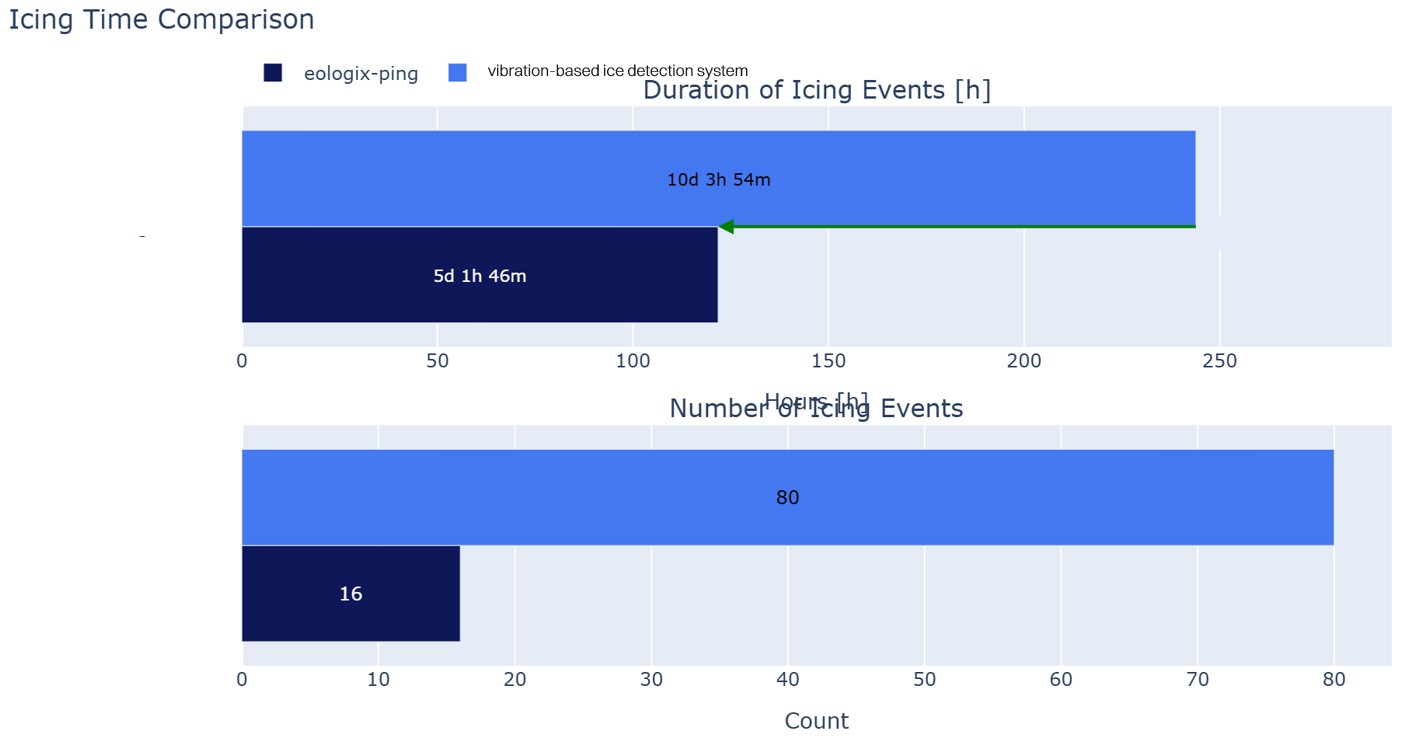
Over the monitoring period from 19 November 2025 to 20 February 2026, the vibration-based system triggered 80 individual icing events with a combined ice-related detection duration of 10 days, 3 hours and 54 minutes. This provided the baseline against which the EOLOGIX-PING system was evaluated.
Copyright: EOLOGIX-PING
What the data showed
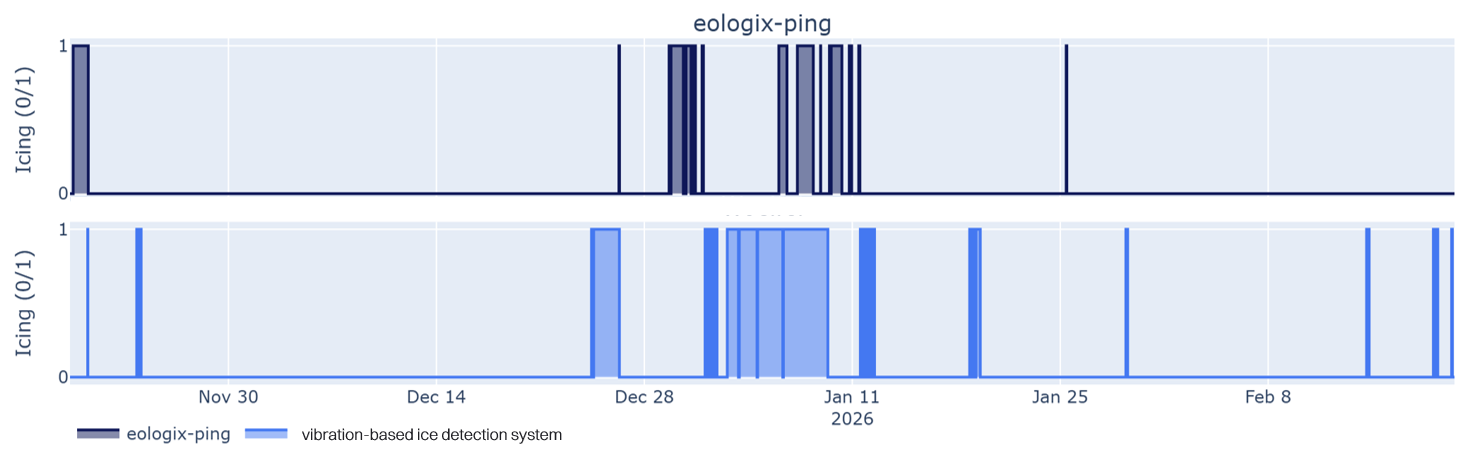
During the same period, the EOLOGIX-PING system detected 16 icing events with a combined duration of 5 days, 1 hour and 46 minutes. This represents a reduction of 51 % in total icing time compared to the vibration-based system on the same turbine.
Copyright: EOLOGIX-PING
Why :RESTART ICE made the difference
- Blade-surface measurement: EOLOGIX-PING sensors are mounted directly on the rotor blade and measure ice accumulation at the point where it actually matters, distinguishing between ice thickness levels from minor activity to confirmed accretion above 15 mm.
- Graduated detection logic: The stop signal is only triggered when specific thickness thresholds are met across multiple sensor positions, reducing false positives caused by moisture, hoarfrost or transient temperature conditions.
- Integrated restart logic: The system continuously evaluates whether blades are clear, enabling faster return to operation once icing conditions have passed, rather than waiting for a manual inspection or a time-based delay.
Copyright: EOLOGIX-PING
Conclusion
The field comparison on a single Enercon E115 over one winter season demonstrates a measurable difference between blade-mounted and vibration-based ice detection. With 51 % less ice-related detection time and significantly fewer individual events, :RESTART ICE showed a more targeted detection profile that more closely reflects actual blade conditions.
Key takeaways
- Direct comparison, same turbine: Both systems ran in parallel on the same Enercon E115, eliminating site or fleet variables from the comparison.
- Fewer events, shorter duration: 16 events vs. 80, and roughly half the total icing time, over the same winter season.
- Practical implication: Blade-mounted sensor technology detects icing conditions more precisely than vibration-based approaches, with the potential to significantly reduce avoidable downtime.
Share this case study

Similar case studies

Get in touch with us
Reach out to us for tailored advice on your specific needs, to learn more about our technology, or to schedule a personal consultation. Our dedicated team is ready to assist you every step of the way.

Subscribe to our newsletter
Stay informed with the latest industry news, fascinating insights, and updates from EOLOGIX-PING delivered straight to your inbox.
PS.: We promise no spam.